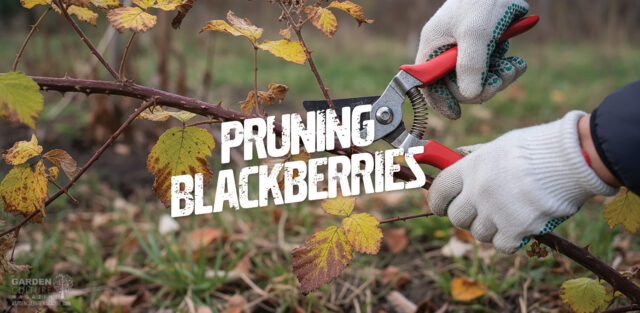
Left unchecked, blackberries form dense, invasive tangles. If properly pruned, they can be tamed.
Blackberry plants are perennials, so an established patch will yield a berry harvest every year! When you prune blackberries, you separate the first and second years of growth. This is essential as the first-year canes (primocanes) do not produce fruit, but if allowed to mix with the second year’s cane growth (floricanes), they will form a snarl of canes that will encourage pests, foster disease, and reduce the plant’s ability to produce fruit.
Signs of Blackberry Disease
Symptoms appear in early summer and are characterized by the sudden death of side branches and dark brown or purple spots (cankers) on all canes. In wet weather, the cankers produce a grey ooze, and in dry conditions, appear fuzzy or powdery. To avoid this, properly prune the plant!
When to Prune
When you prune a plant, you are sending it a message to grow. Pruning can accomplish different things depending on when it’s done.
If you prune in spring or late winter before the plant flowers, you not only get higher fruit yields but also create a stronger plant that can better withstand the weight of heavy fruit and foliage. Fruiting finishes in the late summer or fall, which is the perfect time to cut the two-year-old canes (floricanes) back to the ground and remove them from the garden. The goal is to remove the older floricanes, allowing the plant to divert its energy to this year’s primocanes, which will produce fruit in the ongoing cycle.
How to Prune
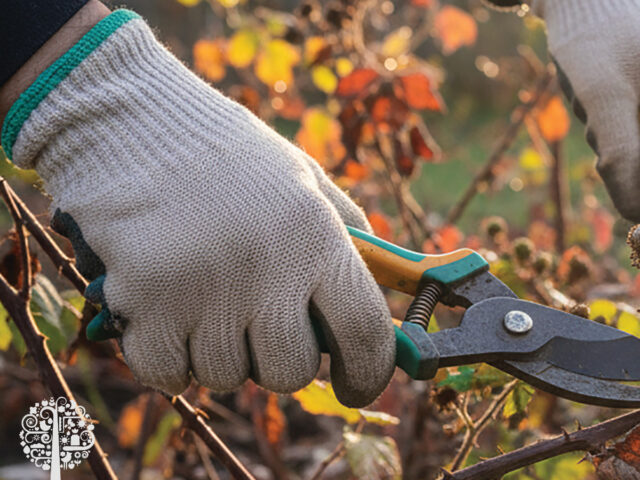
Always start with sterile pruning shears and/or loppers and wear garden gloves. For pruning in late winter or early spring, thin the first-year canes (primocanes) to four to six per plant, and remove any that are damaged or diseased.
This is also the time to prune the lateral branches to increase fruit size and improve penetration of air, sunlight, and water. At the end of your pruning, leave only 4-6 vigorous primocanes per plant. Remove any spent floricanes, dead, diseased, or dying branches. Remove and discard any debris.
Training the Plant
Blackberries fall into several growing-habit categories – erect (or upright), semi-erect, or trailing.
⇒Trailing blackberry plants resemble vines and require support from a trellis or other climbing structure.
⇒ Erect and semi-erect blackberries are more shrub-like with canes that arch to the ground and can support themselves. Semi-erect plants are unable to support their weight well and are distinguished by how some canes, as the name indicates, grow upward from the plant, while others trail. This plant may also need additional support. Grow it against a fence and train the canes as you would on a trellis.
If you take the time each year to manage your blackberries, they won’t become unruly tangles and will produce succulent fruit for up to twenty years.