Mean Gene from Mendocino has been breeding cannabis since the late 1990s in Mendocino County, California – part of the famed Emerald Triangle, known for its top-shelf, sun-grown cannabis and deep legacy roots. Here’s a breakdown of his breeding practices. For seed drops and updates, check out his site or follow him on Patreon.

Mean Gene, describe how cannabis breeding was done back in the day.
The first time I made a lot of seeds was in ’99 in a hidden little garden in the middle of the woods and some hollowed-out bushes; what would be considered a guerrilla garden these days. Everything was hidden under the trees.
Back then, most things were grown from seeds, as opposed to being grown from clones, the way they are now. People still grow from seeds and are doing it more and more. But everything from seed was marketable in those days, so it was less important to have a really specific type of product.
A lot of the seeds would be known as ‘John’s from Down the Road.’ Or it would have the family’s last name attached to it or a certain little road or driveway. And it would usually be some type of Afghani hybrid so that things would finish a little earlier, avoiding cops and robbers. That was the standard back then. In the early 2000s, it shifted, and it turned into clones.

How do you decide what to breed – do you follow trends or instincts?
I choose based on what I like, and when possible, it’s nice if that aligns with a trend rather than trying to jump on one.
What I notice is that by the time something becomes popularized, you’re almost about to miss it. It’s almost better to just stick with doing all the different stuff that you like, and then when the trend switches, as long as you’re doing diverse breeding, you can look through and say, ‘Right now, everybody likes this orangey thing.’ I can go into my fridge and pull out the old orange work that I have. Or when purple’s big. I can make my own thing and then incorporate what’s popular at the time based on their merit.
Sometimes, it works out that I made crosses with Gelato and Runtz and the things that are more contemporary. But you know, those things are already about to be what’s old, and now what’s new is something that was already old before, like a fruit mix kind.
How did your brand, Freeborn Selections, come into being?
Freeborn is actually my middle name. I was making remixes of songs, like mash-ups with turntables and everything. I was trying to find a name for the music. I thought such-and-such Selections would be cool. In Jamaica, they call a song that they picked a selection. A DJ in Jamaica is called a Selector.

What makes your work different from others in the cannabis breeding scene?
I don’t focus so much if somebody is a big commercial producer and they want to get something from me that they can really market. I don’t really gear my work towards that group of people.
I’m more geared towards people who are plant lovers.
If you look at the way food crops work, everybody grows the same few apples or the same few tomatoes. But if you go to a cool apple nursery, they’ll be like, ‘Yeah, we have this one. No one likes to grow it because the skin gets rusting on it. It looks brown and weird, and people want the shiny apple. But this one tastes the best.’ But if you love apples, you might go, ‘What have I been buying this whole time?’
When I see a list of what I’ve put out, I see there’s a lot that I really have worked with for several generations, and a lot went into them. I might mix a bunch of things together, and that takes a lot of time just to get to that point where people call it a poly hybrid. Then I find genetics that pop up repeatedly, and I make them more narrow.
How are you vetting your genetics?
In the old days, nobody really realized that there were any kinds of diseases, but at this point, it’s common for people to get clones, especially from larger operations, with hop latent viroid.
I don’t take clones from people who don’t do testing, and then once I have them, I test them myself. At the very least, you need to have them around for long enough to see what happens to them over some time.
There have been plenty of times when I’ve taken some clones and bred them. But at this point, I really like to see if something is worth it. I make enough now that it’s a lot of work to just get the seed out of the flower. I like to grow every clone out once or twice and see if I really want the seed from it. Once I make the seeds, I grow them out and put them through a lot of stress and pressure. I put them in a light deprivation to force them into flowering.
Everything requires different levels of vetting and testing. In my experience, no matter how well you do it, there will always be issues in a certain environment. It’s a bit of a double-edged sword when trying to stress things too much. But I do try to make sure that anything I put out is, first of all, viroid-free and then fun to grow.
A good product on a good plant; a combination of those things.

What kind of environment are you using?
I’m using 2,500 square feet outdoors. I recently grew some feminized seeds, and the plants I used to produce the pollen had to be kept in a room with very low humidity. If it gets above about 40%, pollen likes to spoil. I keep some stuff through the winters inside, just to keep my mother stock, but I don’t grow indoors.
When doing the light dep, what I have are long, long hoops that people normally cover, but I don’t cover them. The hoops are like a big whale spine. Basically, it’s just the hoops and one board up the middle to keep them sturdy. Then, I have big posts on either side, a cable over the top, and clips that attach to the tarp. And so, from either end, I pull it closed over the top and then close it in the middle. It’s nice because if I want to have different timing, I can plant the earliest things at the ends, and then I can just cover it partially. If I want to cover 6 feet, I can cover 6 feet, and if I want to cover 50 feet, I can cover 50 feet, so I can stagger at different times.
As soon as everything’s done, I have to start the post-harvest process, which involves crushing the material, using air to separate the seeds, and labeling everything. There’s a lot of information to keep track of.
It’s something that a person who was maybe a little more practical or sane, or whatever you want to call it, would probably have a lot of people helping with, but I just do it all; it’s a hobby. And if something doesn’t work out, it’s my fault; if something does, then I take the credit.
It’s all fun.
A big thank you to Mean Gene for taking time away from his plants to sit down with us! Be sure to listen to the entire interview.

Professional POV with Regenerative Cannabis Breeder Reggie Weedman
Meet Reggie Weedman, a cannabis breeder committed to preserving genetic diversity with regenerative farming. See why Canna Country #26 became an award-winning cultivar and why full-spectrum effects matter.

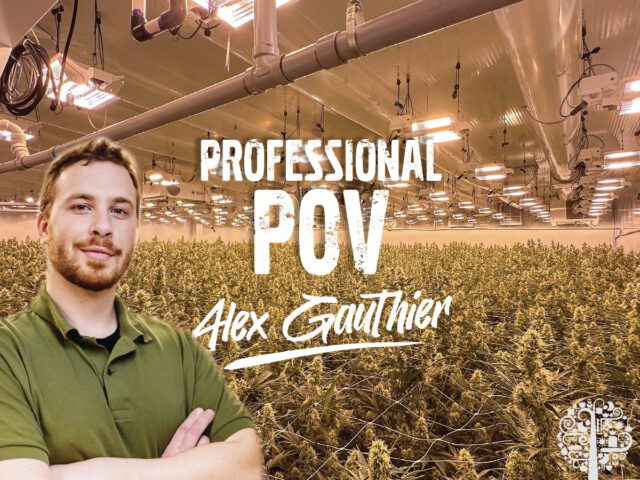
IPM: Professional POV with Alex Gauthier, Origine Nature
How do professional growers keep their rooms free of pests and diseases? In our Professional POV series, Alexandre Gauthier of Origine Nature talks IPM.
Is Europe the New North America? Cannabis Trade and Talk at ICBC Berlin
Garden Culture goes to Berlin! What’s in store for the cannabis world? Haley Nagasaki gives us the buzz from the International Cannabis Business Conference.