How Do You Set Up Plastic-Free Irrigation?
At the end of the growing season, I find myself storing away a seemingly endless supply of plastic containers. From propagation trays and domes to garden center flats and plant starter pots, they pile up in the greenhouse in a big plastic tote, next to one-, two-, and three-gallon plastic containers. I tell myself I’ll reuse them, and I do, but the stack keeps growing.
A familiar story for most gardeners; plastic is ubiquitous in its cheap and convenient form, but it’s also relentless (How cute, the irony that we as consumers in the West each have a credit card-sized mass of microplastics in the brain. Remember that this holiday season, y’all!).
In the garden, we have plastic watering cans and hoses, nutrient bottles, and media bags. Tools, labels, row covers, tunnels, greenhouses, and finally, irrigation pipes. Is there another way to water without plastic? Could it be cost-effective? And could it be used in commercial ag as well as at home?
Top of mind, we have clay tiles and pipes, which the farmers of old used. Galvanized piping is available and pricey; copper might be ideal, but costs an arm and a leg at scale. What about bamboo?
The OG of Plastic-Free Irrigation: Contour Farming
Some permaculture systems thrive on pond-based ecosystems. The Water Wizard of Oregon – Don Tipping, for example, has nine interconnected ponds on his property in southern Oregon.
Watch this informative video about plastic-free irrigation methods by Andrew Millison:
He uses a “multi-pond system with swales and keyline canals to fan the water out over the landscape. Whether we’re doing this actively to irrigate crops, or passively when it’s raining, we’re following the principle that we should slow it, spread it, and soak it,” he says.
Tipping opens the valve of a holding pond, which induces the snaking of “rapid flood flow irrigation” down the slope of his fields to the terraces of his crops.
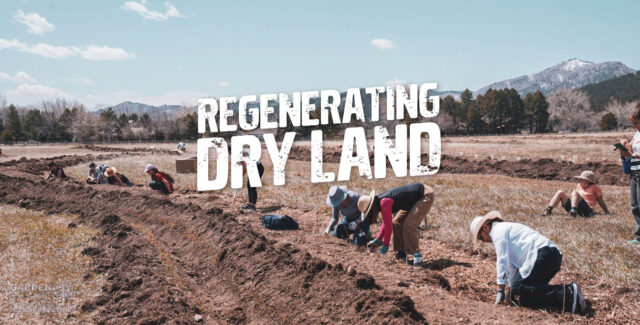
This is called ‘contour farming’ and has been used for millennia as a method that works with the natural contour of the land when planting or plowing. Following elevation lines reduces runoff and soil erosion. Flooding fields in this way removes the need for plastic irrigation pipes entirely.
In the commercial greenhouse, flood tables, which allow plants to absorb water through the bottom of their pots, mimic this permaculture principle on a smaller, more controlled scale.
Olla Irrigation
Last year, I met a new company selling an automated olla watering system, though these systems are anything but new. Olla, meaning pot in Spanish, uses unglazed terracotta pots buried beneath the earth, with the tops above ground filled with water.
A process similar to osmosis, the water leaches out through the porous clay pots and into the surrounding soil. Depending on their size, they only need to be filled twice a week.
An automated system might connect these pots with plastic irrigation lines, though they could be hand-filled or connected with pipes made of other materials. Olla subsurface irrigation safeguards against water waste, surpassing drip irrigation, sprinklers, and hand watering in efficiency.
Clay drainage tiles work to remove excess water from fields, mitigating anaerobic conditions and the buildup of salts and sediment. These tiles might be simple perforated clay pipes or shaped like tiles.
Perforated plastic polymer pipes (say that five times fast) are used mainly today, but the clay pipes are still around! Tiles reduce surface water and runoff, increasing precipitation absorption, while padding the reservoir tank or holding pond.

Metal Irrigation Pipes
The global irrigation company, Rain Bird, did have a subsurface copper dripline. Copper irrigation systems are also being used for plumbing and HVAC; however, the cost is the main deterrent.
The Copper Development Association cites the use of subsurface copper lines installed by plumbers to service crops, lawns, and golf courses.
A small copper system for the home grower could be more cost-effective and involves drilling holes in copper piping, fitting emitters, and installing them above. More of an experiment than a tested method, it’s doable but could cause problems.
Copper is reactive and will corrode with salts or acids. Leaching copper ions in excess can lead to plant toxicity. Galvanized steel is also susceptible to acid corrosion, so this method may be best for growers who cultivate living soil!

Rainwater and Gravity-fed Systems
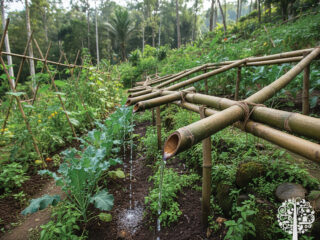
Before poly tubing took over, gravity was Old MacDonald’s best bud. Rainwater collection stored in metal cisterns or wooden barrels enabled growers to irrigate without pumps or polymers. Elevated tanks provide natural pressure, sending water through metal or bamboo piping or directly into clay ollas. Plastic-free irrigation at its best!
Returning to contour systems, large-scale cisterns can integrate into plots without ponds or into greenhouse gutters. Backyard growers can start with a modest barrel and tap.
Who is Viktor Schauberger?

Austrian forester, inventor, and researcher Viktor Schauberger’s life’s work revolved around the idea that water is a living entity that naturally flows in a vortex-like motion, a key to its vitality. His theories have influenced permaculturists, biohackers, and engineers, though some dismiss them as pseudoscience.
Regardless, Schauberger helped design and optimize log driving in Eastern Europe. His systems were used to guide felled logs downstream, drawing on his knowledge of natural water flow. His innovations upheld his belief that working with nature’s forces led to superior solutions.
Aside from logging booms, during his research, Schauberger not only freed water from rigid right-angled infrastructure but also sent it through copper vortex fountains, creating beautiful displays he claimed energized the water. He believed that water, when forced through straight lines, is stripped of life force, and healthy water should spiral and oxygenate, remaining cool as it moves through streams and rivers.
In a world of harsh edges and plastic piping, Schauberger’s legacy reminds us to look to the wisdom of flow: whirling, cool, and alive! How could this play into your garden?