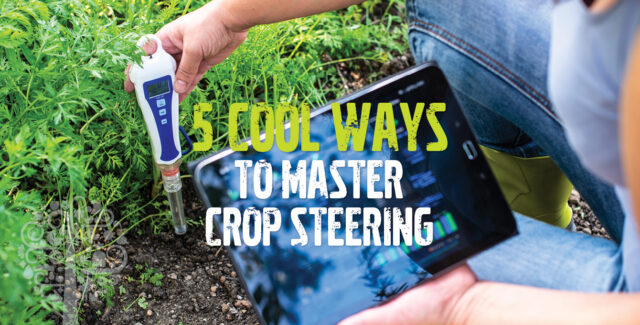
The term crop steering might seem intimidating, but it’s really all about understanding a plant’s fundamental needs and delivering the goods. Pretty basic, right? Luckily, there are several gadgets, tools, and methods to help growers better understand what’s going on below the surface … or above the leaf canopy. Not everything can be solved with a bottle; honing in on various growth factors will help you achieve optimal results in the garden. We’ve got a few ideas in our list of 5 Cool Ways to Master Crop Steering.

1. Vapour Pressure Deficit Monitors
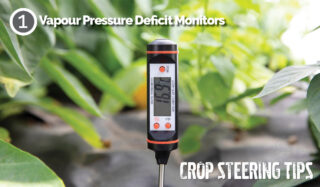
Vapour Pressure Deficit (VPD) is a hot topic for indoor growers, because monitoring and regulating it can help mitigate or even prevent many problems during the vegetative and flowering stages. VPD is the amount of water the air in a room can hold when saturated. A high VPD means the room is hot and dry, and your plants are thirsty. A low VPD indicates a cool and muggy environment, leaving crops susceptible to rot and disease. Investing in a quality VPD monitor will help keep your room in check and lead to healthy, flavourful harvests. Many of these compact gadgets can measure room temperature, humidity, and VPD, sending the information directly to your smartphone. Infrared leaf-temperature sensors are excellent tools for measuring VPD at the source. Plugging the information into a VPD chart can help keep you and your plants in the green zone. Growers who understand VPD have better success because they start using other controls properly, including humidifiers, dehumidifiers, thermostats, lighting, and fans; all the pieces of the puzzle come together.
2. Irrigation Tools
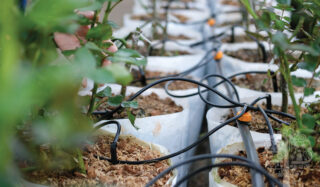
Crop steering and irrigation go hand in hand, and that’s because getting moisture levels right promotes better root growth. Saturating a growing medium for extended periods will discourage plant roots from growing deeper and reaching for moisture. If the medium is too dry, plants will wilt. It’s a delicate balance, but a good-quality moisture sensor will make it attainable. Many options on the market let growers monitor moisture levels on their smartphones so they can plan irrigation before their crops get thirsty. A tensiometer is another option for gauging how hard the plants are working to take up moisture. Of course, there’s the good old-fashioned grow room walk-through to pick up grow bags and check water levels. We always recommend spending time observing the garden rather than exclusively depending on technology! Once you’ve determined your plants need water, how you deliver it is up to you. Doing it by hand with a watering can is perfectly fine, but setting a digital irrigation timer and connecting it to hoses or drip lines ensures your plants get what they need, even when you’re not there.
3. Grow Lights and PAR Meters
If only a successful indoor grow was as easy as turning on some lights! We know plants need the rays to photosynthesise, but how much is too much? Enter the trusty PAR meter, a tool that measures the amount of light crops receive from artificial lighting. This gadget helps prevent under- or over-lighting, leading to healthier plants and better energy efficiency. Speaking of efficiency, many growers have switched from HID to LEDs because LEDs last significantly longer and reduce irrigation needs. Studies also show that yields and quality under LEDs exceed those under HID. If you’re in the market for new grow lights, use a PAR meter to take readings from all parts of the garden so you know the intensities your plants need in various growth stages; this will help you choose the right LED fixture for the space. Remember, the grow light industry is constantly evolving, so it’s essential to stay up to date on current technology and determine what’s best for your grow.
4. pH Matters When You Master Crop Steering
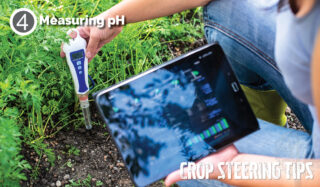
When it comes to pH levels, every plant has a sweet spot for optimal growth. pH measures the acidity or alkalinity of soil; when levels are too high or too low for a specific plant, the absorption of essential nutrients becomes more challenging. Most plants prefer a pH range of 6 to 7, but it’s best to know precisely what your crop needs and adjust accordingly. Testing pH levels can be done in many ways; the least expensive options are litmus paper or a basic soil pH test kit. However, the results will likely be less accurate. A wide variety of pH probes exist at different price points; spend the extra money to get one that performs well. Professional growers tend to read pH levels with either the dilution paste method or the pour-through method, both of which require a top-quality pH probe but deliver highly accurate results. Understanding and correcting pH is one of the best ways to steer plants towards success.
5. Master Crop Steering Basics
Not everything has to be fancy when it comes to crop steering; whether you realise it or not, even the most basic of tools can help plants reach their full potential. For example, a good pair of pruning shears or scissors can be used to shape, trim, and stress plants (in a good way!). Stakes and trellis are perfect supports for vining and tall-growing plants, or other crops you want to train upwards. It’s good to have a plant mister or fog machine on hand for plants that need a little extra humidity. Finally, we won’t blame you if you’ve got a few copies of Garden Culture Magazine in the grow room; we’re always game to steer you in the right direction!

Plant Steering in Organic Container Systems: Working With, Not Against, the Soil
Switching from hydro to soil? Learn how organic container systems and living soil changes plant steering, feedback loops, and grower intuition.
Watering like a Boss: Irrigation Techniques and IPM
Proper irrigation techniques can be part of an integrated pest management strategy. Andrea Keddy writes about watering skills that help keep plants healthy.

5 Cool Ways to Expertly Forage for Wild Mushrooms
Anyone can become a mushroom forager, no fancy degree required! Mountain micologist Whitney Johnson offers her top wild mushroom foraging tips, free of charge!