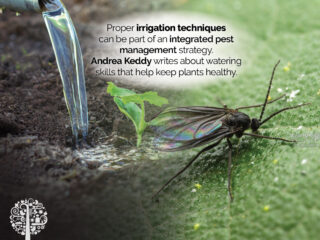
Proper irrigation techniques can be part of an integrated pest management strategy. Andrea Keddy writes about watering skills that help keep plants healthy.
My mentor was adamant about proper irrigation techniques, or watering skills, when I was a young apprentice grower in a commercial ornamental greenhouse. We followed the rule that you can always add more. Over-watering can cause numerous issues for a grower, from increasing pests and diseases to disrupting the oxygen balance in the root zone.
We spent hours irrigating, watering lightly according to the expected weather conditions for that day, and then returning to add more as needed. It was labor-intensive, but it saved us a significant amount of time over the entire growing process. We reduced the chance of needing dry-down periods and kept pest and disease problems from taking over.
Watering: A Common Problem
As a pest management consultant, I often see water-related IPM issues, particularly insect pests living in the root zone. Fungus gnats and shore flies can reach high numbers when the root zone is consistently moist. In low populations, these pests will likely leave your roots alone, preferring to eat organic materials, fungi, and algae. But when the environment tips in favor of the insects and is soggy for prolonged periods, we see a population explosion, and they may feast on the plant roots.
When it comes to proper irrigation techniques, the more we reduce the soil’s oxygen content by over-watering, the greater root death we see, which increases the food source (dead root tissue) for the larvae of these pests. This is especially damaging to young developing plants. The attack on young root hairs reduces the uptake of water and nutrients for the plants and creates a wound for pathogens to take up residence. Heed caution, gardeners!
Watering and Plant Pathogens
Pythium is one of many plant pathogens commonly found in greenhouses and root zones. It flourishes in wet environments. Once the hyphae develop inside the plant tissues, they release destructive enzymes that absorb nutrients. Pythium is extremely difficult to control without systemic fungicides and often causes plant death.
As these pests’ larvae develop into adults, they fly around and move from plant to plant. They carry pathogen spores on their feet and bodies, and the Pythium pathogen remains viable as it passes through the insect’s gut and spreads through excrement. If this happens, treating the insects carrying the disease and the disease itself is essential, or this vicious cycle will continue.
Valuable Lessons in Watering
Overwatering may seem like a small misstep, but for growers, it can quickly spiral into serious problems. To recap, when the root zone stays too moist, it disrupts oxygen balance and creates the perfect breeding ground for pests like fungus gnats and shore flies. These insects don’t just swarm—they attack young root hairs, reducing the plant’s ability to absorb nutrients and water while opening the door for pathogens.
And again, one of the most dangerous culprits, Pythium, thrives in these conditions and is notoriously hard to control without systemic fungicides. Once it’s in, plant death often follows. That’s why it’s essential to treat both the disease and the pests that spread it. As simple as watering seems, it’s an art that demands attention, experience, and restraint.
I am grateful to my mentor for these lessons in proper watering techniques. A task that appears so simple is an art form that requires practice and diligence. Remember, an ounce of prevention is worth a pound of cure. Following the rule that “you can always add more” is key.
Mastering moisture means mastering the balance between care and control!
Andrea has worked in the horticulture industry for over 20 years and specializes in using beneficial insects as the primary defense against pests. As a technical consultant with Koppert Canada, she works with growers advising on pest management strategies in crops such as greenhouse-grown vegetables, ornamentals, and cannabis. Andrea loves being in nature and is passionate about growing various food crops while supporting a biodiverse regenerative ecosystem.
Cookies are used on this website to give you the most relevant experience by remembering your preferences and repeat visits. By continuing to use this website, or by clicking Accept Cookies, you consent to the use of cookies on this website.
This website uses cookies to improve your experience while you navigate through the website. Out of these, the cookies that are categorized as necessary are stored on your browser as they are essential for the working of basic functionalities of the website. We also use third-party cookies that help us analyze and understand how you use this website. These cookies will be stored in your browser only with your consent. You also have the option to opt-out of these cookies. But opting out of some of these cookies may affect your browsing experience.
Necessary cookies are absolutely essential for the website to function properly. These cookies ensure basic functionalities and security features of the website, anonymously.
Cookie
Duration
Description
cookielawinfo-checkbox-analytics
11 months
This cookie is set by GDPR Cookie Consent plugin. The cookie is used to store the user consent for the cookies in the category "Analytics".
cookielawinfo-checkbox-functional
11 months
The cookie is set by GDPR cookie consent to record the user consent for the cookies in the category "Functional".
cookielawinfo-checkbox-necessary
11 months
This cookie is set by GDPR Cookie Consent plugin. The cookies is used to store the user consent for the cookies in the category "Necessary".
cookielawinfo-checkbox-others
11 months
This cookie is set by GDPR Cookie Consent plugin. The cookie is used to store the user consent for the cookies in the category "Other.
cookielawinfo-checkbox-performance
11 months
This cookie is set by GDPR Cookie Consent plugin. The cookie is used to store the user consent for the cookies in the category "Performance".
viewed_cookie_policy
11 months
The cookie is set by the GDPR Cookie Consent plugin and is used to store whether or not user has consented to the use of cookies. It does not store any personal data.
Functional cookies help to perform certain functionalities like sharing the content of the website on social media platforms, collect feedbacks, and other third-party features.
Performance cookies are used to understand and analyze the key performance indexes of the website which helps in delivering a better user experience for the visitors.
Analytical cookies are used to understand how visitors interact with the website. These cookies help provide information on metrics the number of visitors, bounce rate, traffic source, etc.
Advertisement cookies are used to provide visitors with relevant ads and marketing campaigns. These cookies track visitors across websites and collect information to provide customized ads.