Have you ever come across “helpful advice” like this on a bag of potting soil or a feed chart?
When I first started working with living soil, I wanted to find a precise way of managing moisture content. It’s no secret that it’s easier to overwater soil-based potting mixes than soilless ones—so I was keen to find a way to dial things in.
It wasn’t long before I discovered an instrument called a “tensiometer”—a tool that completely transformed how I approach soil moisture management. I’ve learned a great deal from using tensiometers to master moisture in living soil, so I thought it was time to share!

Like many growers, I’ve often relied on the fairly manual method of simply lifting pots and judging moisture content by weight (or back strain) or poking my index finger rudely into the soil. But living soil uses much larger containers—10 gallons (about 40L) is a bare minimum—and raised beds are often used, too.
A quick lift is out of the question when working with these large volumes of dense, organic living soil! Not only are these pots or beds way too heavy, but the soil’s surface can be deceiving—it can look and feel dry, while deeper down, there’s still plenty of moisture.
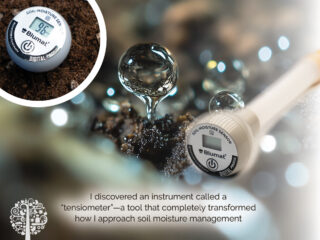
So, what exactly is a tensiometer? I like to think of it as an “artificial plant root.” A tensiometer is a hollow tube filled with water, capped with a vacuum gauge at the top and a porous ceramic tip at the bottom, which is inserted into the soil.
When the soil dries, it exerts suction on the ceramic tip and water inside the tensiometer. This suction from the soil —or tension—is what the gauge measures. The reading tells you precisely how hard your plants are working to draw water from the soil. A high reading means your soil lacks moisture, which can stress your plants. A low reading indicates moisture is easily accessible.
Tensiometers are available from a few companies and come in various sizes. The most common and cost-effective model is the Blumat Digital. This has a maximum measurement depth of approximately 8″ (20cm) and is effective for pots or beds. Irrometer makes higher-end tensiometers that use a dial vacuum gauge rather than digital and come in a wider range of sizes. These allow measurements to be taken up to 12″ (30cm) deep, which is great for beds.
Tensiometers give growers invaluable clarity over their irrigation.
Suddenly, watering decisions are straightforward and measurable rather than based on guesswork or intuition.
It’s worth appreciating the subtle and important difference between soil tension and volumetric water content (VWC). While VWC simply indicates how much water is physically present, soil tension is a measure that’s arguably conceptually closer to the plant’s physiology; it tells you how hard plants need to work to access that water. Two soils can have identical VWC readings with significantly different soil tension.
For instance, using VWC meters and physically weighing the pot, I’ve tested our Eco-Life peat-based living soil alongside our coco-based Living Soil, and the results were eye-opening. At identical VWC, the peat-based mix consistently showed lower tension, meaning water was more easily accessible to plants. This made me realise why coco coir mixes perform better when they run slightly wetter! I love those moments when experiments and data backup are growing experiences. I now think of coco coir as a sort of “greedy sponge” when it comes to holding on to moisture!
While we are discussing peat vs. coco coir, when coco coir is run at a lower tension (wetter), the physical structure of the media still retains plenty of air, which is beneficial for root growth and biological activity. Peat mixes generally tend to have a finer physical structure, so when you reach higher moisture levels (lower tension), there can be less air space. Peat mixes are often more sensitive to overwatering than coco coir. Can you tell I love coco coir?

Tensiometers are generally placed where the action is—directly into your root zone, typically halfway down your container or bed, with the ceramic tip around 6-8″ (15-20cm) deep. If you’re working with large containers or beds, placing multiple tensiometers tactically around the space is ideal. In beds, using a longer tensiometer such as the Irrometer LT 300 (that can measure up to 12″ (30cm) deep) helps get a better understanding of how the water fluctuates deeper down in the soil profile. Multiple readings can provide valuable insights and a clearer picture of moisture distribution.
In my experience, the ideal range for tensiometer readings in living soil is around 40-100 millibars. When readings climb between 70-90 millibars, it’s time to start thinking about watering soon. Anything above 100 millibars indicates that your plants may be experiencing some moisture stress. Of course, fine-tuning, depending on your soil type, is necessary to get dialled in.
When plants are in vegetative growth, most growers aim to provide consistent and easy access to moisture. When plants enter transition, it’s common to up the ante slightly and steer plants decisively into generative production with tensiometer readings up to 100-120 millibars. Once flowering has commenced, the soil tension can be reduced slightly until it’s time to induce senescence (ripening) towards the end of the cycle, when soil tension can be increased once more.
From my trials and errors, here are a few key tips to ensure your tensiometers remain accurate and reliable:

Over time, I’ve observed that living soils also change significantly. As organic matter breaks down, the soil compacts accordingly, altering its ability to retain moisture. Without accurate monitoring, it’s easy to end up with dry pockets or overly saturated zones, both of which can harm plant health and the soil’s vital microbial community.
It’s difficult to overstate the importance of maintaining soil structure. Coco coir and peat are organic matter, which naturally breaks down over time, leading to higher water-holding capacity and reduced drainage, often referred to as soil compaction. This can be observed over multiple cycles in living soil through a physical hand-squeeze soil inspection, but it can also be detected through your tensiometer readings. You will notice a tendency for the tension to decrease over time, remaining lower for longer periods.
To counter this, I routinely amend my living soil with around 4-5% pumice every three or four cycles. These additions maintain a balance of air and water, ensuring even moisture distribution and enhancing the soil structure.
I also moved away from strictly no-till gardening to gently mixing in the amendments when preparing beds for a new cycle. Mixing the soil down to 8-10″ (20-25cm) depth at the end of each cycle can reveal areas of dryness or compaction and allows me to adjust watering strategies, keeping the soil consistently productive.
Since incorporating tensiometers into my gardening routine, I’ve experienced significantly improved consistency, healthier plants, and a thriving microbial environment. The guesswork of watering has been replaced with precise, measurable action, leading directly to better plant health and productivity.
I strongly encourage growers—whether you’re just getting started or have been gardening for years—to explore the benefits of tensiometers in their living soil practices. The initial investment in these devices quickly pays off through healthier plants, better yields, and fewer headaches.
As the living soil revolution gains momentum and more growers adopt this cultivation method, I strongly recommend investigating tensiometers as part of the transition. They aren’t just gadgets—they’re a central part of growing efficiently, consistently and successfully with soil.
To learn more about tensiometers and moisture management, visit my Ecothrive blog (ecothrive.co.uk/blogs/news), where I regularly share insights and experiences from my living soil journey.

Should you test your indoor soil? Hell, yes! Dustan McLean says testing organic soil is a crucial step that indoor growers shouldn’t skip.

Gardening in dry climates presents a wide range of challenges, with watering being one of the biggest. Anne Gibson shares her top irrigation techniques.

Proper irrigation techniques can be part of an integrated pest management strategy. Andrea Keddy writes about watering skills that help keep plants healthy.