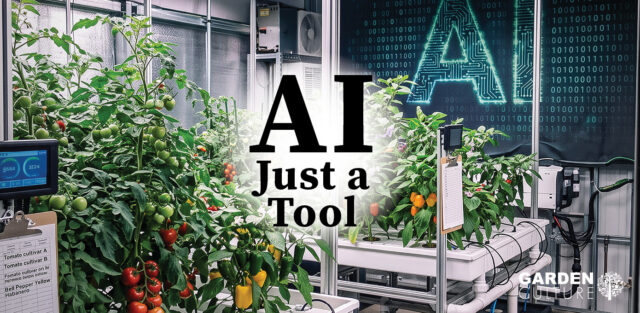
AI in the Grow Room? Artificial intelligence is increasingly being used in modern cultivation. Robin Koehorst writes that its true value and limitations depend entirely on the grower behind the data.
Do Not Let a Toddler Fix Your Grow Room
Artificial intelligence is a useful tool for cultivators. But it is exactly that – a tool. The value of a tool depends on the user’s knowledge. You would not hand a scalpel to a toddler and expect brain surgery. Likewise, AI in the grow room cannot and does not compensate for poor cultivation practices or a poorly designed room.
A cautious approach to AI is a smarter bet than relying on it for data analysis, systemic improvement, and effective crop cultivation. Using AI to fix a bad grow room can set you up for failure. AI can only enhance your actions if you are using it correctly.
Good Data Starts on the Grow Room Floor
Disciplined action in a grow room is key to quality. A clean grow room, structured cultivation, calibrated sensors, and basic crop competence are the first critical steps to a systematic production cycle.
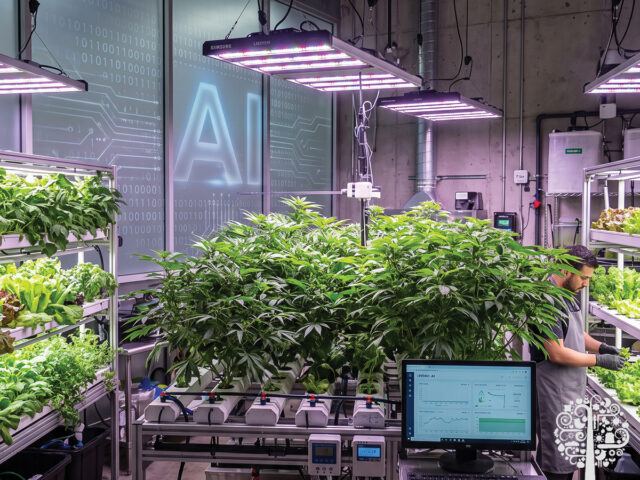
Garbage operations produce garbage intelligence. A grow room requires expertise in logically setting up equipment to communicate with AI effectively. Enhancing a production cycle with AI can only work if everything is physically set up to feed the tool the precise information it requires.
AI can give us data summaries and actionable tasks based on accurate prompts. AI can only provide correlation events and not causation events. To generate accurate information using AI, an expert must be looped in to ensure that the output is representative of the grow room floor. Without expert knowledge, information generated by AI can result in multiple failures on all fronts. For example, AI cannot verify whether a sensor has been calibrated, irrigation lines are functioning correctly, or if measurements reflect what is happening in the room. Those judgments still require experienced growers.
Good data does not come from AI. It comes from good cultivation.
Faking Foundations
Building a solid foundation for cultivation is critical. The temptation to cut corners when AI generates easy, seemingly correct answers can reduce the need for checks and balances, as we have become accustomed to AI’s ease of use. There is an urgent need to remove any temptation to rely on quick, easy AI-generated instructions.
A clean room requires correct design. It requires sensors that are logically and intelligently placed. If four sensors are placed at different heights, AI cannot guess that the heights are different. It can only act on what it knows; otherwise, it generates the wrong data. The action items it generates may be incorrect because it lacks accurate physical information.
If a CO2 sensor has an exceptionally long response time, AI may interpret it as the room not reaching its target. It may have already reached the target, but the sensor is taking a long time to read it. The room-temperature sensor in a canopy, or above it, will give two different readings. AI cannot distinguish between the readings because it is unaware of the sensors’ locations.
AI is not in the grow room designer’s head, and it cannot understand where you may wish to place the sensors. A data collection system is built using intelligent, inclusive, and holistic design. Holistic design is making sure that the sensors talk to each other. The designer understands what the sensors are talking about and where they are talking from. Only the designer can feed that information into AI.
AI cannot read the room – it is not a person.
Dirty Data? Not Great for AI in the Grow Room!
Feeding raw data into AI can generate data analysis. We are not disputing that. However, asking AI to generate analysis without informing it that, for example, the machines generating the data are nutrient sources will create incorrect readings. AI will extrapolate what it thinks the devices are based on the generated readings. If AI is not informed that Machine 1 is dosing fertilizer, it is operating on incomplete data.
Accurate data and understanding of the physicality of a grow room require human input. A grow room cannot have incorrectly installed infrastructure that is not ready for integration. A solid foundation, including proper sensor setup and integrated equipment, provides a stronger basis for generating accurate data.
AI Can Act if Information is Administered Accurately
AI is exceptionally good at identifying patterns. It is far less capable of determining why those patterns exist. AI cannot tell the difference between correlation and causation. For example, if you are growing in a hydroponic system and there is a root pathogen, it can affect water uptake and the water’s electrical conductivity (EC) trends. EC means how easily electricity can move through the water, in response to the amount of fertilizer salt in the water. More fertilizer means a higher EC. Too high an EC is not good for the plant.
If a grower does not know there is a root infection and is using AI to interpret the problem, AI will make assumptions about water and EC trends. AI can give the grower instructions on what to do, but it will correlate events rather than analyze causation. This could mean your roots rot.
Misinformation will kill your plants.
Accountability Cannot Be Automated
Paper is still powerful. Leaving a paper trail will ensure effective data collection, representation, and analysis. Calibration logs can be automated, but they still require user sign-off. Without sign-off, this can create end-user issues in the post-harvest, GMP processing, and packaging step of the production cycle. Any issue with the plant that is addressed incorrectly can be harmful. A machine cannot take responsibility for documentation that is processed without oversight. Only a human can take responsibility for an effective production cycle.
Final Thoughts on AI in the Grow Room
Blaming AI is ethically irresponsible. Using AI without oversight, cross-checking, and sign-off can result in a garbage grow room and, even worse, a crop that can cause harm to its end user.
Artificial intelligence can make good growers more efficient, more consistent, and better informed. It cannot create competence or compensation for poor systems or bad data. In cultivation, responsibility still belongs to people. AI in the grow room can support good decisions—but it cannot replace the judgment, discipline, and accountability that produce exceptional crops.