Universal Thrip Control Playbook? Here is Part 1
I want to start this installment with a note: I am a firm believer in the adage “there’s more than one way to skin a …” skin whatever you’d like, friends; this is a judgment-free zone. I have managed my own and many other cultivators’ IPM and disease-related issues for over 20 years and have a lot more scars than winning stories to share. With this said, I am certain some will find fault with this information as it isn’t how they’d do it, and that’s fine. This is a possible road map for some, and for the naysayers, I hope at minimum these ideas challenge the way you think because no matter how you slice it, these little bastards want nothing more than to feast on your bottom line.
There will be a lot of buzzwords and terms in this series, so I apologize in advance if your PTSD is triggered. You’ve already lost the battle if you approach your IPM program like it’s a magic wand. I was told on more than one occasion by a well-skilled head grower that the value of a single cuke lost across a range far exceeds your budget for control. Let that sink in.
No matter the venue, the single biggest commercial mistake I have seen growers make is waiting until damage appears to initiate action. If a single female thrip can live for up to 60 days and pump out 300 eggs in her lifetime, how do you play catch-up? A reactive approach will always cost more in the end. I know the C-suites and Directors of the world will always focus on COGS and KPIs; however, emergency knockdown releases are costly and reactive, and the damage done before you gain control will be immeasurable.
Out on the field, they say defense wins the game; in commercial cultivation, this is no different. You need to live the mantra: Start Clean, Stay Clean, End Clean.
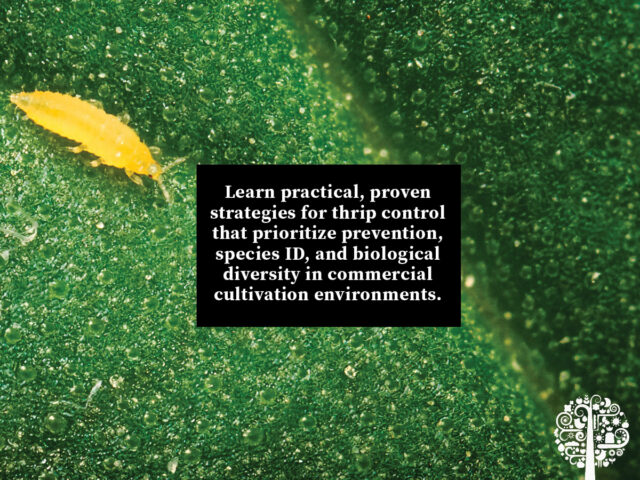
The Critical Warning on Species & Overall Sanitation
Not all thrips are created equal; this is another point that needs to sink in. What works for one may not be as effective for another.
The following protocols were developed to manage Western Flower Thrips (WFT) and Onion Thrips (Thrips tabaci). I am sad to tell you that if you’re dealing with Thrips parvispinus, this playbook will fail miserably. With over 20 years in the field, I still have a hard time identifying thrips without a microscope. If you are unsure which species is in your crop, reach out to your local ag extension or connect with a trusted IPM consultant. Knowledge reigns supreme; know your enemy and proceed accordingly.
General sanitation is next on my list, and, like the buzzwords/terms mentioned earlier, we also have some cliché sayings. Cleanliness is next to godliness (in all facets of life), especially in commercial cultivation. Your grow should drip: “ain’t nobody dope as me, I’m just so fresh, so clean.” Visitors (which you should never have if you adopt the mantra) should be intimidated by how clean your grow is; you want them to think “…maybe this is too nice a place for me to be today…”.
Detritus isn’t just an eyesore; it offers up an all-expenses-paid luxury vacation home for pupating thrips (and others). Stay clean like a hospital. Old plant waste or medium lying around is a lazy rookie mistake that will feed the fire of future infestations (and impact your KPIs; don’t we love corporate?).
Phase 1 of the Universal Thrip Control Playbook: Your Foundation (Mother Stock)
This is ground zero. Keep your stable CLEAN. End of story. This approach should set you up for a flawless finish (well, almost flawless, we’re all human, aren’t we?). If the stable is riddled with thrips, so will every baby that comes out the other end. And because we are all hunters of the elusive golden egg, and you keep these long-legged beauties for so long, your approach must be multilayered to not only control the root zone but also the canopy.
Subterranean Defense
- Soil Predators: Deploy a 50/50 blend of Stratiolaelaps scimitus (Hypoaspis miles) and Gaeolaelaps gillespiei at a rate of 50/m². Splitting these species creates functional biological diversity in the root zone. Diversity is key in building a program. Say it with me now: “Diversity is key.” Remember this: although there is no quiz at the end, it is some sage advice worth adopting.
- Rove Beetles: Introduce Dalotia coriaria(Atheta coriaria) at 2/m2, ideally not all at once. It is best to split your application into two separate introductions of 1/m², spaced a week or two apart. Staggering the intro will allow for more overlapping life stages and ultimately fewer peaks and valleys in activity. If possible, find a source product in your jurisdiction that has multiple life stages rather than just adults.
Canopy Management & Supplemental Feeding
- Predatory Mites: A loose intro of Amblyseius swirskii at 50/m² is standard practice and should be done on establishment/planting of new moms. Weekly follow-ups should be done as maintenance; 10/m² across the entire space is a safe amount to keep on hand each week. Pending the canopy is touching (or you have deep pockets), deploy sachets at 0.5 sachet/m² (or 1+ sachet per large mother). Whenever possible, use a longer-duration sachet – ask the supplier what their definition of long duration is, and bank on the low end of their answer for a window of efficacy. An added note on the sachets: they take about a week to “release” – plan accordingly, as a week is a long time and you could miss the target.
- Cattail Pollen & Feeder Mites: Your Swirskii (and Cali) populations thrive on a diet of supplemental protein (pollen). Look at adding pollen to your crop like the universe chucking your preferred source of protein from the sky. Weekly applications of pollen will maximize predatory mite health and keep them in the upper canopy, where the action is happening. Don’t go all kumbaya on me and treat the swamp like a supplement store for the biocontrols; it goes without saying that you will need to find a reputable source for the pollen. (Note: Ensure your QA team clears the source and use of pollen first. If pollen runs into regulatory roadblocks, sterile feeder mites make an excellent substitute and can be sourced with many suppliers of biological controls).
- The Global Pollen Rule: Pause all pollen applications immediately if your weekly scouting report is showing an increase in thrips or whitefly. Sadly, pollen is an indiscriminate food source. The bad actors with chow down just as hard as your beneficials. Sterile feeder mites during a flare-up are a solid pivot, and tbh you likely have enough mobile protein for your predatory mites as it is.
- Minute Pirate Bugs (Orius): Orius insidiosus should be introduced at 0.5–1.0/m². To keep Orius happy and healthy (and laying eggs), feed them Ephestia eggs.
The Captain Planet Sticky Note Hack for Ephestia Eggs: Seeing as some of us grew up as aspiring “planeteers,” the environment outside matters just as much as what we are dealing with inside. Standard sticky notes can be sliced into strips the width of a finger and used to pick up Ephestia eggs. The adhesive is perfect in the sense that it’s weak and will hold the eggs but not catch any of the Orius. Place some Ephestia eggs in a shallow bowl, then dip the adhesive end of the strip into the bowl to collect the eggs. Once collected, add the strips to your moms and near entry points. This will give the Orius a nice meal, which in turn gets you better overall activity and increased egg-laying capacity. The beauty of all of this is when you send the crew through to clean or flip the room, the waste is 100% compostable and can go out with the green waste. This message is Captain Planet approved.
The Propagation Trap: Taking a Grip of Cuts can cost the program
Tender new plant shoots are where Orius love to lay eggs. The next generation of your beneficial army will be impacted every single round of cuts you and the crew take. Once again, we are reminded of grade school mathematics and the order of operations – make sure to account for the losses and plan your intros to coincide with the production schedule.
Knockdowns & Sequence
If an influx occurs, match your defense to the life stage: Swirskii for early larval instars, Orius for late instars and adults.
If you deploy adult Orius alongside an aggressive sticky-card campaign, the sequence dictates success. Never hang fresh sticky cards immediately after releasing flying beneficials. If you deploy traps while flying predators are still seeking canopy cover, a huge chunk of your financial investment will end up dead on the glue.
If chemical knockdowns are required:
- Entomopathogenic Fungi: Bio-pesticides containing Beauveria bassiana or Metarhizium species can effectively target thrips; however, they are a double-edged sword. What helps control thrips can also eliminate your Orius population. One of my oldest friends and the person who taught me most of what I know about growing plants once said, “Choose your battles wisely, young man,” and this fits that statement like a glove.
- Nematodes (Steinernema feltiae): Foliar nematode sprays, in theory, sound great; however, to execute properly isn’t an easy feat. To be successful, the nematodes need a continuous film of moisture and complete darkness (lights off/fans off/screens pulled/hvac?) to survive. Drenches are highly effective but come with a caveat: drenches only target what is residing in the medium.
Phase 2 of the Universal Thrip Control Playbook: Cuttings & Propagation
Clean moms should yield clean cuts; that said, maintenance in a propagation dome requires a steady hand.
- Targeted Microbials: Regular “fogs” of the dome environment with entomopathogenic fungi (Beauveria or Metarhizium) can be highly effective at dropping anything that squeaked through the first round. It is also advisable to add either of these products to a nematode drench for your young cuttings, provided the developing plants can handle it.
- Carrier in Trays is a NO NO: Broadcasting loose predatory mites in vermiculite or bran carriers directly into trays or over the canopy is suicide. If this is on your mind, skip this step, throw the entire tray away, and start over. Learn from my donkey mistakes of yesteryear; this will ruin your results. Carrier material was never intended to be in 100%rh. It will settle against stems and stick to leaves, causing rot and decay to develop at a pace you have never experienced before. This is a bad idea and should be avoided at all costs.
- Transplant ReUp: Once les bebes are ready for TP, plan to introduce Gaeolaps and Hypoaspis as you would for any new planting (see notes on rates and ratios earlier in the article).
The Times are Changing: Do NOT use Dalotia coriaria(Atheta coriaria) from this point forward. Dalotia/Atheta are very mobile; if you release them at this stage, you will likely end up with adults welded to sticky flowers down the line.
Universal Thrip Control Playbook: The Next Episode…
Now that you have the program tuned up to manage the stable and have some ideas for managing your cuts, how do you keep this going without ending up with Mids? The second episode digs into the next steps for the veg and flower, considerations for sachets that we lightly touched on, mass trapping in general, and the non-negotiables for commercial cultivation, no matter the crop.