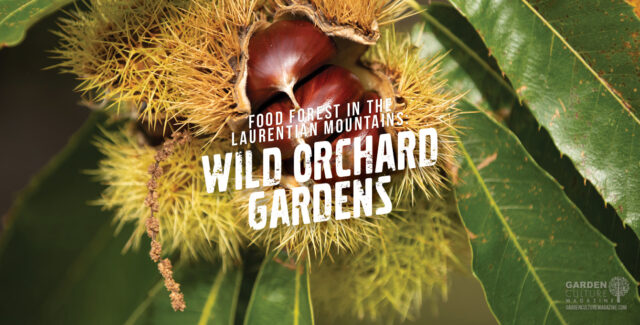
The main work of a food forest is meant to be harvesting. That’s a pretty good sell for anyone who has tried to grow food successfully. There are so many models, most anciently the Garden of Eden, though you might avoid that apple variety.
I grew up in a small suburban garden in Southern California surrounded by fruit trees, a small pond and vegetable garden, a hen house, and rabbits. I planted the second forest garden in Georgia in an old pecan grove. By then, I could integrate permaculture practices into a garden. The third was an urban version in Montreal between buildings, and the fourth was in a UK allotment. Each of these varied settings supported a garden that embodied at least some of the design principles of a food forest.
Finally, in my sixth decade, I have landed on the south-facing hillside of an actual forest. And because we are on the Canadian shield, we have rocks. Often seen as a thorn in the side of garden cultivation, many of these are so large that they stack nicely into walls that support terracing. They collect and radiate heat into whatever grows before them, creating micro-climates throughout the garden. This terraced forest garden also integrates the principles of a food forest.
It was interesting to plant a forest garden surrounded by an actual forest. Even in our poor, rocky soil, the mycelium network insinuates itself into plantings, enriching what the plants have to work with. The nut trees are interplanted with existing maple and beech. They benefit immediately from this, as long as one has dealt with the light issues.
I planted nut trees as a substitute for grains. Like all trees, they bring up nutrients from deep within the soil. However, the nutrition carried in nuts is different from that of commercially grown grains, and they store well for a few years. Fruit trees and berry bushes also gather nutrients widely and hand them over in fruit that can be processed for the winter. And the great blessing is that none of this ever has to be replanted. Once they are established, it’s down to the mulching, pruning, and harvesting.
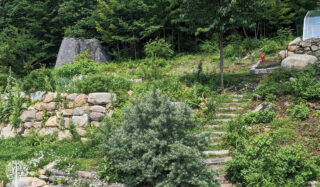
My garden features a collection of 50 walnut, hazelnut, and chestnut trees, 35 apple, pear, plum, peach and cherry trees, five kinds of berries and two grape varieties. I have also snaked in a collection of perennials to balance winter diets. Add asparagus, Jerusalem artichokes, perennial chard, perennial herbs, and an array of wild native plants; throw a root crop harvest into the mix from the growing season, and one has a passable, pretty balanced winter diet. It’s not food entertainment, but it’s undoubtedly eating well.
Forest gardens are mainly about design, planting, and then waiting for the trees and shrubs to mature and begin to yield groceries. Here is a checklist of considerations to make as you embark.
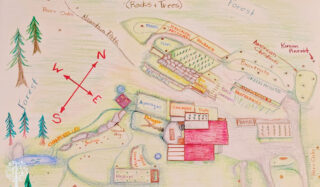
As I mentioned, one of the design principles is to plant down from an “edge” toward the south (or even west). For instance, planting forward from the outside edge of a forest in descending plant sizes. What are your borders, and how can you best move forward from them? South-facing walls and fences present excellent edges. However, a west-facing wall could be a wonderful home for a grapevine, and growing vertically integrates a large vining plant in an otherwise unused space.
Whether your food forest is a collection of plants surrounding a single tree or a more full-blown version, take time to plan it, but don’t hesitate to make it happen.
Marci’s recommendation for further reading: Edible Forest Gardens, by Dave Jacke, volumes one and two.

It’s small-scale food production following permaculture practices and can be done almost anywhere. Jennifer Cole explains the many benefits of food forests.
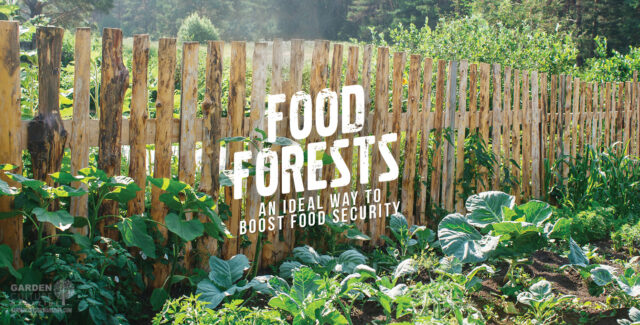
Some initiatives deserve to be applauded, and Atlanta’s giant food forest is one of them. The seven-acre plot is the largest such space in all

A food forest is a permanent agricultural system that layers edible plants together. The secret to success is making sure fungal populations are thriving!