I’m one of those obsessed gardeners who keeps one eye on the plants and another on the weather. During torrential rain, precious potted plants are pulled under cover so as not to drown. In a freeze, they are sheltered. I am constantly checking weather apps to get ahead of the next Pacific storm, and I regularly flip through the pages of the Farmer’s Almanac, hoping for clues on when the next cold Arctic front or drought might arrive.
You’ve undoubtedly heard of the Farmer’s Almanac and Old Farmer’s Almanac. For over 200 years, these illustrious publications have provided gardeners and farmers with the best time and date to plant scarlet runner beans and other precious food crops. Wondering if the best time to harvest tomatoes is during a waxing or waning moon? The almanac has the answer. But bar none, their most infamous claim to stardom is their weather predictions.
Although both publications each boast an accuracy of 80%, a 20th-century study compared five years of predictions to actual conditions and found that their forecasts were about 50% accurate.
So, which is the best crystal ball for your vegetable garden? Research and social media statistics might help you decide.
Founded in 1792, Robert B. Thomas believed Earth’s weather was influenced by magnetic storms on the sun’s surface. He developed a secret weather that’s been refined over the years. The almanac now uses three disciplines to make long-range predictions:
How they work together remains a secret, but you might grab a few clues by joining their many followers on Instagram: @oldfarmersalmanac.
The Farmer’s Almanac is sometimes called the “New Farmer’s Almanac” and was founded in 1818. Its formula also considers sunspot activity, the moon’s tidal action, and the planets’ position. The editors deny using computer or satellite-tracking equipment, weather lore, or groundhogs. The only person who knows the exact formula is the almanac’s weather prognosticator, who uses the pseudonym Caleb Weatherbee. Find them on Instagram: @farmersalmanac.
Environment Canada (@canenvironment) predicts weather using satellite images, radar technology, and manned and unmanned weather stations throughout Canada. All the data goes to computer programs that extrapolate what could happen. In 2014, the Toronto Star asked Jason Samenow, weather editor for the Washington Post, if he thought Environment Canada’s seven-day forecast was accurate. He said yes and that it has a 70% success rate. Environment Canada, unlike both almanacs, does not suggest the best day to plant peas. You’re on your own for plant dates!
When discussing the weather and long-range predictions for the garden, some say the best forecaster is Punxsutawney Phil. Belonging to a cohort of soothsaying groundhogs, Phil lives in Pennsylvania and is noted for predicting an early end to winter or six more weeks of doom and gloom.
His method is basic. He emerges from his hole on Feb. 2nd, and if he sees his shadow – you can expect six more weeks of winter. As for the historical accuracy of his predictions, it turns out that Phil was only right in predicting an early spring seven out of 15 times. At least he’s the mascot of his club, Groundhog.com, and has an Instagram following @Punxsyphil – me now included.
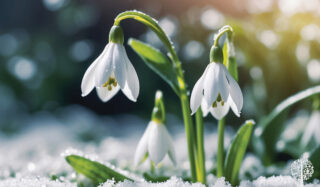
A gardening friend once told me that her grandmother said snowdrops were a sure sign of spring. The ground had warmed enough for them to break the surface, and it was time to plant. What do you think? What’s your guiding light for springtime planting?

The joys and responsibilities of gardening change with each season and this time of year is always a busy one. Spring, or more specifically, the

Moon planting is a gardening technique as old as time, but it’s seeing a resurgence as people look to get back to their roots. Here’s how it works.

A gardener’s work is never done. As many of us spend these cooler fall days raking leaves and cleaning out our flower beds, it’s important